March 25, 2026
Record Sargassum Headed for the Florida Keys, What It Means for Fishing
Let me be straight with you. There’s a wall of sargassum coming, and if you’re fishing the Florida Keys this spring, you need to know what that means.
The University of South Florida just released their 2026 sargassum outlook, and the numbers are staggering. Over 10 million metric tons already measured in the Atlantic as of February, a record for that month. The bloom hit early this year thanks to warmer-than-normal ocean conditions, and the forecast has it arriving in the Keys within the next couple of weeks. Broward and Miami-Dade are looking at April or May.
Dr. Chuanmin Hu, the oceanographer tracking this from USF, put it bluntly: “The worst is yet to come.”
What is sargassum?
Sargassum is a free-floating brown seaweed that drifts in massive mats across the Atlantic. NOAA classifies it as critical habitat for sea turtles and marine life. In the open ocean, it’s a floating ecosystem. On the beach, it’s a rotting, fly-attracting mess that costs counties millions to clean up.
But here’s the thing most news articles won’t tell you. In the right amounts, sargassum is a fishing goldmine.
The good: sargassum lines are fish magnets
Every offshore captain in Islamorada knows this. You find a clean sargassum line, you find fish. Period.
Mahi-mahi are the headliners. They stack under sargassum mats like they’re getting paid to be there. A defined weed line with clean blue water on both sides? That’s the play. Pitch a live bait or cast a fly under that line and hold on.
Tripletail are the sleepers. These weird, flat fish literally float on their sides under sargassum clumps, looking like a piece of debris themselves. Most anglers have never caught one because they’ve never looked for them. Sight-fish with a live shrimp or small crab on a jighead. One of the most underrated gamefish in the Keys.
Wahoo run the deep edges of major weed lines, especially where current pushes the sargassum into defined edges against clean water. High-speed trolling along the outside edge of a heavy line is a proven pattern.
Juvenile sailfish, blackfin tuna, and jacks all use sargassum as ambush cover. The food chain starts with the tiny crabs and shrimp living in the weed, and everything else follows.
The bad: when there’s too much
There’s a tipping point. A defined weed line is a gift. A solid carpet of sargassum stretching for miles is a nightmare.
Line management becomes a full-time job. Every retrieve fouls with weed. Trolling lures collect so much sargassum they stop swimming. Live baits get buried. Kite fishing, our bread and butter for sailfish, becomes nearly impossible when the surface is matted.
Props and intakes suffer. Heavy sargassum mats can clog raw water intakes and foul props, especially on outboards with low pickups. We’ve had days where we’re clearing the intakes every fifteen minutes.
The bite window shifts. When sargassum is everywhere, fish don’t concentrate along defined lines anymore, because there’s no “edge” to key on. The pattern becomes scattered, and that makes finding fish harder even though they’re still out there.
What we’re watching
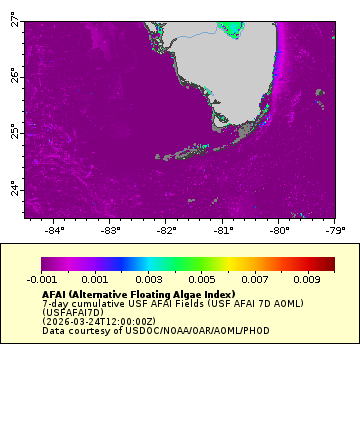
Right now, late March 2026, we’re tracking the sargassum front using satellite imagery daily. The current situation:
- Offshore Islamorada: Scattered patches on the Gulf Stream edge, nothing concentrated yet
- Straits of Florida: Increasing density over the past week, moving with the Florida Current
- Approaching from: Southeast, pushed by trade winds and the North Equatorial Current
- Timeline: Light arrivals expected within 1-2 weeks. Peak density likely April through June based on current drift models
We’ll be updating this daily in our Captain’s Log, including satellite-based sargassum charts when available.
How we’re adjusting
When the weed arrives in force, the playbook changes:
- Target the edges, not the middle. Find where the sargassum line meets clean water. That’s where predators patrol.
- Switch to weedless rigs. Trolling switches to skirted ballyhoo rigged with weedless hooks. Casting with weedless soft plastics becomes the move.
- Run shallower. When offshore gets matted, the reef line between 60-120 feet often stays cleaner. Kings, cobia, and yellowtail don’t care about sargassum. They’re on the bottom structure.
- Fish the current. Where current pushes sargassum into tight lines instead of spreading it, that’s where the action concentrates.
- Dawn patrol. Early morning before the wind pushes the mats together tends to offer the cleanest windows.
The bottom line
Record sargassum is coming. That’s not a question. The question is whether it arrives as defined fishing lines or a solid carpet, and that depends on winds and currents over the next few weeks.
If you’re booking an Islamorada fishing charter this spring, don’t cancel. Some of the best mahi fishing I’ve ever seen has been during moderate sargassum years. The key is having a captain who knows how to read the weed and adjust.
We track sargassum conditions daily alongside our reef-by-reef conditions reports. Check the Captain’s Log every morning for the latest, or book a charter and let us handle it.
Whether you book DirtyBoat, luxury Islamorada fishing charters aboard Miss Penny, or Islamorada sportfishing on Just Cuz, every captain in our fleet knows how to read the weed and put you on fish.
The weed is coming. The fish are coming with it. Let’s go get them.
Targeted in this report