July 5, 2026
17 Schoolie Mahi: Deep Water Blitz Off the Islamorada Hump
Late Start, Long Run
Some days the dock doesn’t release you on time. July 5th was one of those mornings — the kind where the coffee’s cold before the lines are off and half the marina’s already a smudge in the mirror. We got out late. No excuses, no drama, just a late push.
But here’s the thing about fishing the Keys in July — the ocean doesn’t care about your schedule. She’s got her own clock, and on this day, she was running hot.
We cleared the reef line and pointed the bow southeast, running hard toward blue water. The plan was simple: find the life, find the fish. Within a few miles of open ocean the story started writing itself — giant weed mats scattered across the surface like floating islands, and above them, birds. Frigates and terns wheeling and diving, blowing past each mat like they had somewhere important to be.
That’s when you know. The fish aren’t inshore today. They’re out deep, and they’re hungry.
FishIntel Called the Shot
I’d been watching the FishIntel.ai data all morning. The platform had flagged a convergence zone stacking up right off the Islamorada Hump — where the Gulf Stream pushes against the continental shelf and piles up current, bait, and everything that eats bait into a narrow band of chaos.
We hit that zone and the water told the truth. Color change. Temperature break. Scattered weed lines running parallel to the current edge. Life everywhere.
But the real data — the stuff that separates a good day from a great one — showed a secondary convergence pushing further offshore. Twenty-six miles out. Past the Hump. Into the swordfish grounds.
So we kept running.
1,500 Feet of Blue and Chaos
Twenty-six miles offshore, the bottom drops away. You’re floating over 1,500 feet of cobalt blue nothing, and everything alive knows it. This is where the deep scattering layer rises at dawn and dusk, where the pelagics stage, where the food chain compresses into a narrow band between sky and abyss.
And on this day, it was absolutely going off.
Sets of working birds as far as you could see. Not just a few scattered terns — organized, aggressive packs of birds hammering bait pods on the surface. Underneath them, the water was boiling. Mahi crashing through flying fish. Flashes of green and gold erupting through the chop.
We trolled into the first set and it was instant chaos. Rods bent, drag screaming, fish cartwheeling across the spread. Schoolie dolphin — bright, hot, and mean. The kind that hit like they haven’t eaten in a week and fight like they’ve got somewhere to be.
Box ’Em Up
We worked set after set. Every pod of birds held fish. Every weed line had dolphin stacked underneath. The pattern was textbook — run to the birds, deploy the spread, hook up, box the fish, find the next set.
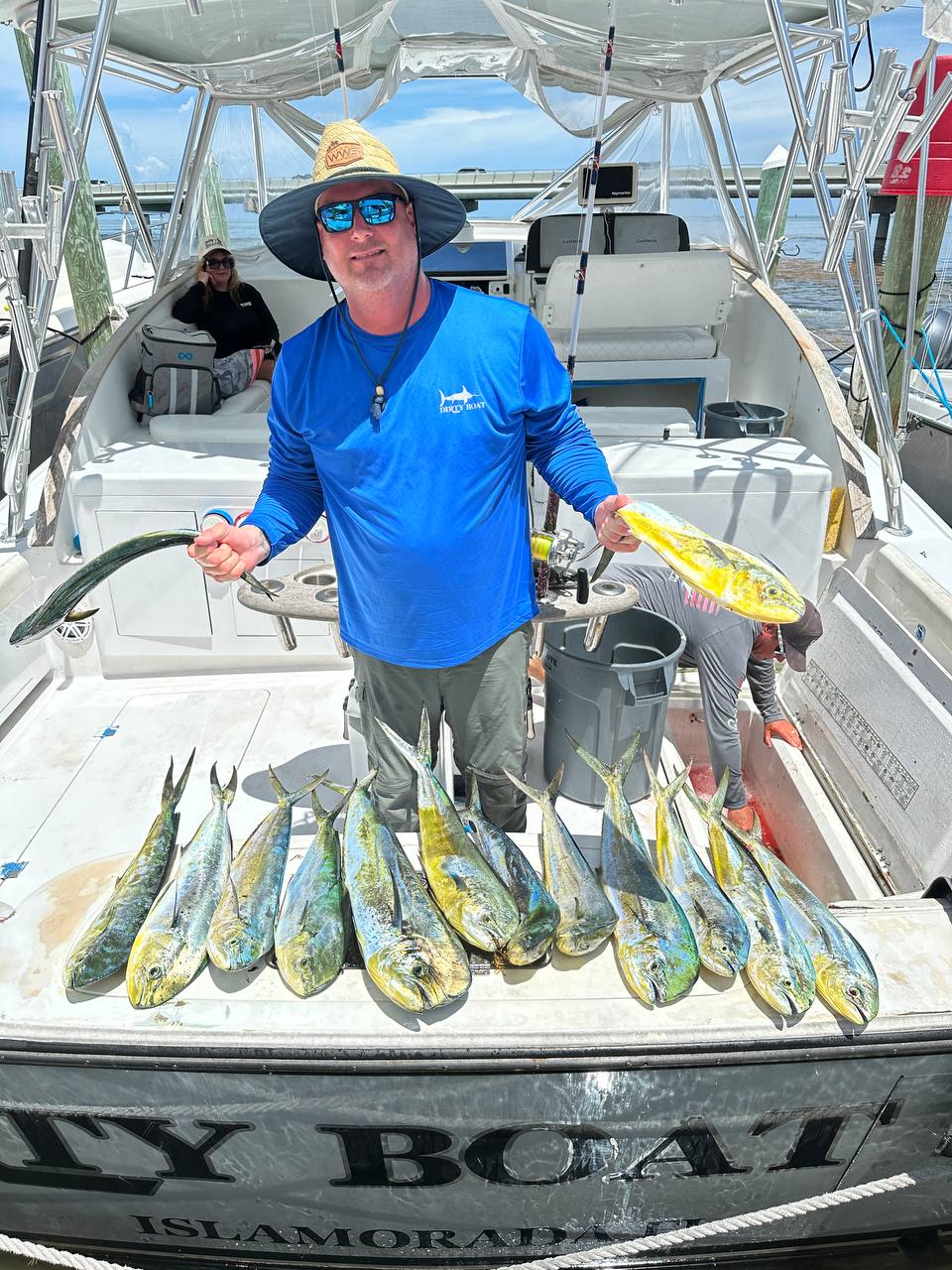
Seventeen schoolie mahi to the box. Every single one of them caught in that deep blue zone past the Hump, right where the convergence data said they’d be.
The crew put in work. Fish after fish, gaff shots on point, ice flowing, blood on the deck. That’s a July day in the Florida Keys — sweat, salt, and a cooler so full you’re standing on fish to close the lid.
The Ride Home
With the box stacked and the crew grinning, we pointed the bow back toward Islamorada. Twenty-six miles of open Atlantic between us and the dock, nothing but blue water and a clean wake behind us.
Days like this remind you why you run offshore. Why you trust the data. Why you push past the obvious spots and keep going when the birds say keep going.
FishIntel called the convergence. The ocean confirmed it. And seventeen mahi paid the price.
The bite is on. July in the Keys means offshore dolphin, and the deep water past the Islamorada Hump is stacked right now. If you want to load the box with mahi on the Dirty Boat, book your trip today.
Tight lines from Islamorada. 🎣